Carpenter Ants Damage Homes in Davenport — Act Fast
Published May 8, 2026 · Updated May 8, 2026
Most ant problems in Davenport are a nuisance. Carpenter ants are different.
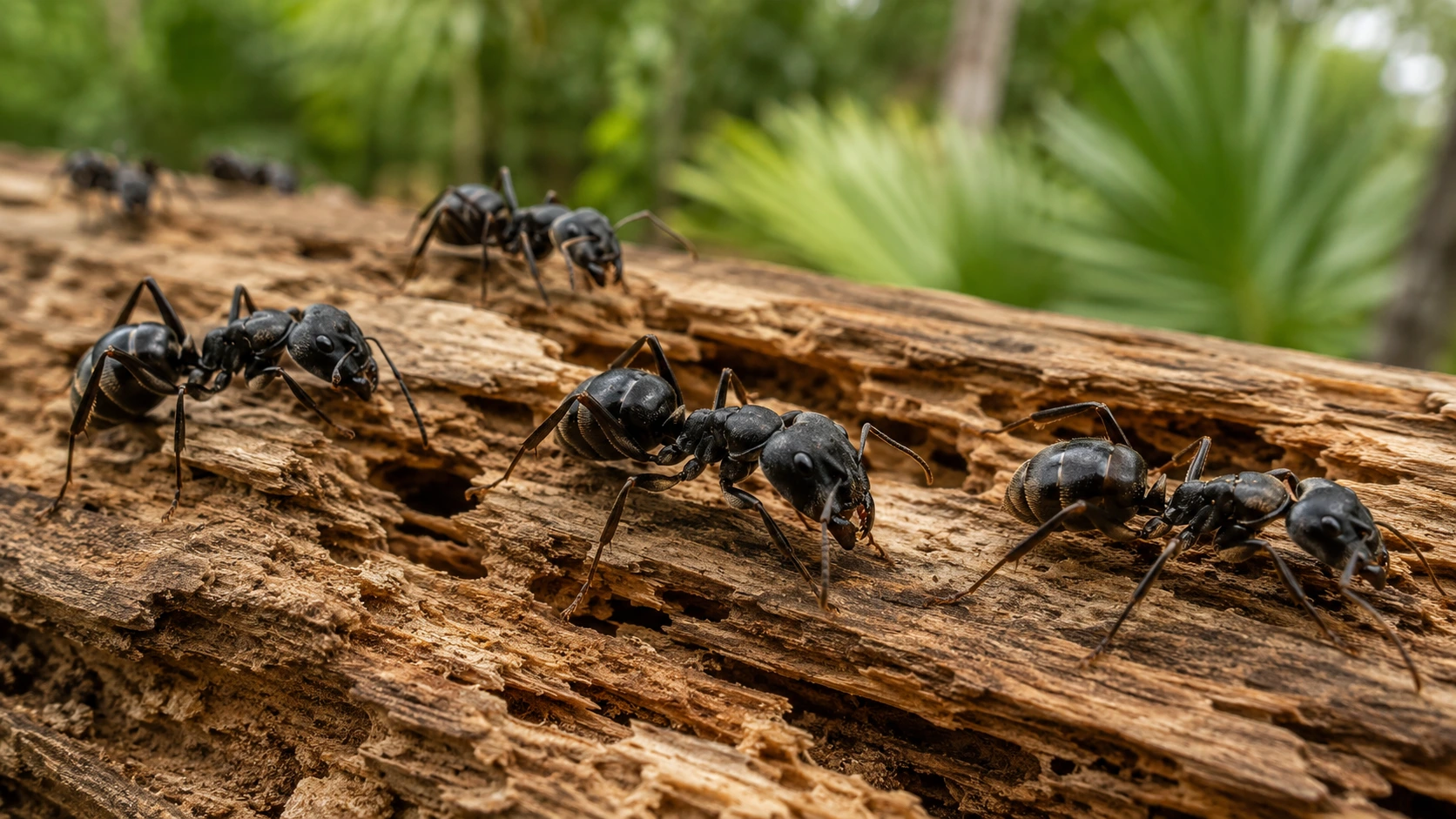
When you see a trail of large black ants moving along your baseboard, across a window frame, or disappearing into a crack near your door — that’s not just an annoyance. That’s a warning. Carpenter ants damage wood by tunneling through it to build their nests, and in a Florida home, the wood they target is often structural.
The frustrating part is that carpenter ants damage happens slowly and quietly. By the time you notice the ants, the damage is usually already underway. Here’s what you need to know to catch it early, understand what you’re dealing with, and stop it before it gets expensive.

Ready to Take Back Your Home?
What Makes Carpenter Ants Different From Other Ants
Most ants you’ll encounter in Davenport are foraging for food or water. They’re a nuisance, but they’re not destroying anything. Carpenter ants are in a different category entirely.
Carpenter ants don’t eat wood — that’s a common misconception. What they do is excavate it. They tunnel through wood to create smooth-walled galleries where the colony nests and raises young. The tunneling is clean and precise, which is why carpenter ant damage is often mistaken for termite damage by homeowners who discover it.
The distinction matters because the treatment is completely different. And the urgency matters because unlike a trail of sugar ants on your counter, a carpenter ant colony in your wall is actively removing material from your home’s structure every day it goes untreated.
The Florida carpenter ant (Camponotus floridanus) is the species most commonly found in Davenport homes. According to the University of Florida IFAS Extension, they are one of the largest ant species in Florida, with workers ranging from 1/4 to 1/2 inch in length. They’re typically black or dark reddish-brown and are most active at night, which is why many homeowners don’t realize they have a problem until the infestation is well established.
How Carpenter Ants Get Into Davenport Homes
Carpenter ants don’t start inside your home. They start outside, in a primary colony typically located in a dead tree, a rotting stump, or a piece of decaying wood somewhere on or near your property. From there, they establish satellite colonies — smaller nesting sites that the main colony uses to expand its territory and raise young. Your home’s wall voids, window frames, and roof line are prime satellite colony locations.
The path they take to get inside is almost always connected to moisture-damaged wood. Carpenter ants strongly prefer wood that has already been softened by water damage, fungal decay, or prolonged moisture exposure. Perfectly dry, sound wood is much harder for them to excavate. This is why carpenter ant problems in Davenport so often involve:
- Wood in contact with soil — fence posts, deck framing, exterior trim that sits close to the ground
- Areas with chronic moisture — around leaking windows, beneath poorly sealed exterior doors, in soffits or fascia that retain water
- Landscape mulch against the foundation — this is one of the most common and overlooked entry vectors in Davenport. Mulch holds moisture against the exterior wall, softens any wood it contacts, and provides cover for ants to move unseen from the soil to your home
New construction in the Davenport area sometimes uses mulch heavily in landscaping beds along the foundation line. If that mulch is within six inches of your exterior wall, you’re creating conditions that carpenter ants specifically look for.
How to Tell If You Have Carpenter Ants Damage
Catching carpenter ants damage early is the difference between a targeted treatment and an extensive repair. Here are the signs to look for in and around your Davenport home:
Large ants near wood structures — Seeing one or two large black ants is not necessarily a problem. Seeing them repeatedly in the same location — especially near a window frame, door frame, baseboard, or ceiling junction — is a red flag. Carpenter ants follow established trails between the main colony and satellite colonies.
Frass near wood surfaces — Carpenter ants push debris out of their galleries as they excavate. This material, called frass, looks like coarse sawdust mixed with insect body parts and is typically found in small piles below or near the entry point. If you find what looks like sawdust near a baseboard or windowsill with no obvious explanation, look closely — carpenter ant frass is a strong indicator of active damage.
Hollow-sounding wood — Tap on wood surfaces in areas where you’ve seen ants. Sound wood gives a solid thud. Wood hollowed out by carpenter ant galleries gives a hollow or papery sound. This is most detectable in door frames and window sills.
Rustling sounds in walls at night — Carpenter ants are nocturnal. In a quiet house at night, an active infestation inside a wall can sometimes be heard as a faint rustling or crackling sound. If you hear this near a window frame or along an exterior wall, take it seriously.
Winged ants indoors — Winged carpenter ants — called swarmers — appearing inside your home is a strong indicator of an established indoor colony. Swarmers are reproductives that emerge when the colony is mature and ready to expand. Finding them inside means the colony isn’t just visiting — it’s living there.
Carpenter Ants vs. Termites — How to Tell the Difference
This is one of the most common questions we get from Davenport homeowners, and it’s an important one because the treatment and urgency levels are different for each.
The fastest way to tell them apart:
- Body shape — Carpenter ants have a clearly segmented body with a pinched waist. Termites have a thicker, more uniform body with no visible waist.
- Antennae — Carpenter ant antennae are bent or elbowed. Termite antennae are straight and bead-like.
- Wings (if present) — Carpenter ant swarmers have two pairs of wings of unequal length, with the front pair noticeably larger. Termite swarmers have two pairs of wings that are equal in length and roughly twice the length of the body.
- Frass — Carpenter ant frass is coarse and mixed with debris. Termite frass (drywood termite pellets specifically) is more uniform, smaller, and granular.
If you’re still not certain, don’t guess. Our ant identification guide covers the most common species in detail, and a professional inspection will tell you definitively what you’re dealing with.
Why Acting Fast Matters With Carpenter Ants Damage
Carpenter ant colonies grow slowly compared to some species. A mature colony typically takes three to six years to fully establish. But that timeline works against you — by the time the colony is mature enough to produce swarmers and become highly visible, it has been quietly excavating for years.
The practical implication: if you’re seeing large black ants consistently in or around your home, don’t wait for more evidence. The evidence you’re waiting for is the damage getting worse.
A small satellite colony caught early can be eliminated with targeted treatment before significant structural damage occurs. A mature, well-established colony with extensive galleries in a wall void or roof structure requires more aggressive treatment and often repair work on top of it.
Carpenter ants damage is also not covered by standard homeowner’s insurance in most cases — it’s considered a pest infestation rather than sudden damage. The cost of treating and repairing carpenter ant damage falls entirely on the homeowner, which is another reason early action is worth it.
Ready to Take Back Your Home?
What You Can Do Right Now
While you wait for a professional assessment, there are steps you can take immediately to reduce the conditions that attract carpenter ants to your Davenport home:
- Pull mulch away from your foundation — Create at least a six-inch gap between any mulch or organic ground cover and your exterior wall. This single step eliminates one of the most common entry pathways.
- Fix any moisture issues around windows and doors — Check the caulk and weather stripping on all exterior openings. Soft or discolored wood around a frame is a sign that moisture has already gotten in.
- Remove dead wood from your property — Rotting stumps, dead trees, and old lumber piles are primary colony sites. Eliminating them removes the source colony that satellite colonies depend on.
- Store firewood away from the house — Firewood stacked against an exterior wall is an ideal carpenter ant habitat. Move it at least 20 feet from the structure.
- Look for and seal exterior cracks — Use a caulk gun to seal any cracks or gaps in your exterior wall, particularly around utility penetrations and where different building materials meet.
How Professional Carpenter Ant Treatment Works
Effective carpenter ant treatment addresses both the satellite colony in your home and the primary colony outside it — because eliminating one without the other is only a partial fix.
Interior treatment typically involves non-repellent insecticide applied to wall voids and suspected gallery areas, combined with targeted bait placement along established ant trails. Exterior treatment focuses on a perimeter application around the foundation and targeted treatment of any suspected primary colony sites on the property.
In cases where the colony is well established inside a wall, void injection may be necessary to reach the galleries directly. A thorough inspection determines the scope before any treatment begins.
Learn more about our perimeter treatment service and our indoor ant control service to understand what a full carpenter ant treatment looks like from start to finish. And if you’re on a new construction lot in Davenport with landscaping mulch near the foundation, ask about our prevention plan — getting ahead of carpenter ants is significantly easier and cheaper than treating an established infestation.
Don’t Wait on This One
Most ant problems in Davenport can wait a few days while you figure out what to do. Carpenter ants are the exception. Every day an active colony spends inside your walls is another day of excavation. The damage doesn’t stop when the ants aren’t visible — it continues around the clock inside the wood.
If you’re seeing large black ants repeatedly in or near your home, call us. We’ll identify what you’re dealing with, assess the extent of any damage, and put together the right treatment plan for your specific situation.
One call. Same-day service available.