Ant Identification Guide for Davenport Homeowners
Published May 8, 2026 · Updated May 8, 2026
Before you treat, you need to know what you’re dealing with.
That sounds obvious, but it’s the step most Davenport homeowners skip. They see ants, they grab a product, they spray. The ants come back. They grab a different product. The ants come back again — sometimes in greater numbers, sometimes in a new location. The cycle continues until they call a professional who does in thirty seconds what should have happened first: identifies the species.
Ant identification matters because different species require completely different treatment approaches. What works on fire ants will do nothing for ghost ants. What eliminates odorous house ants can cause pharaoh ants to scatter and multiply. Getting it right starts with knowing what you have.
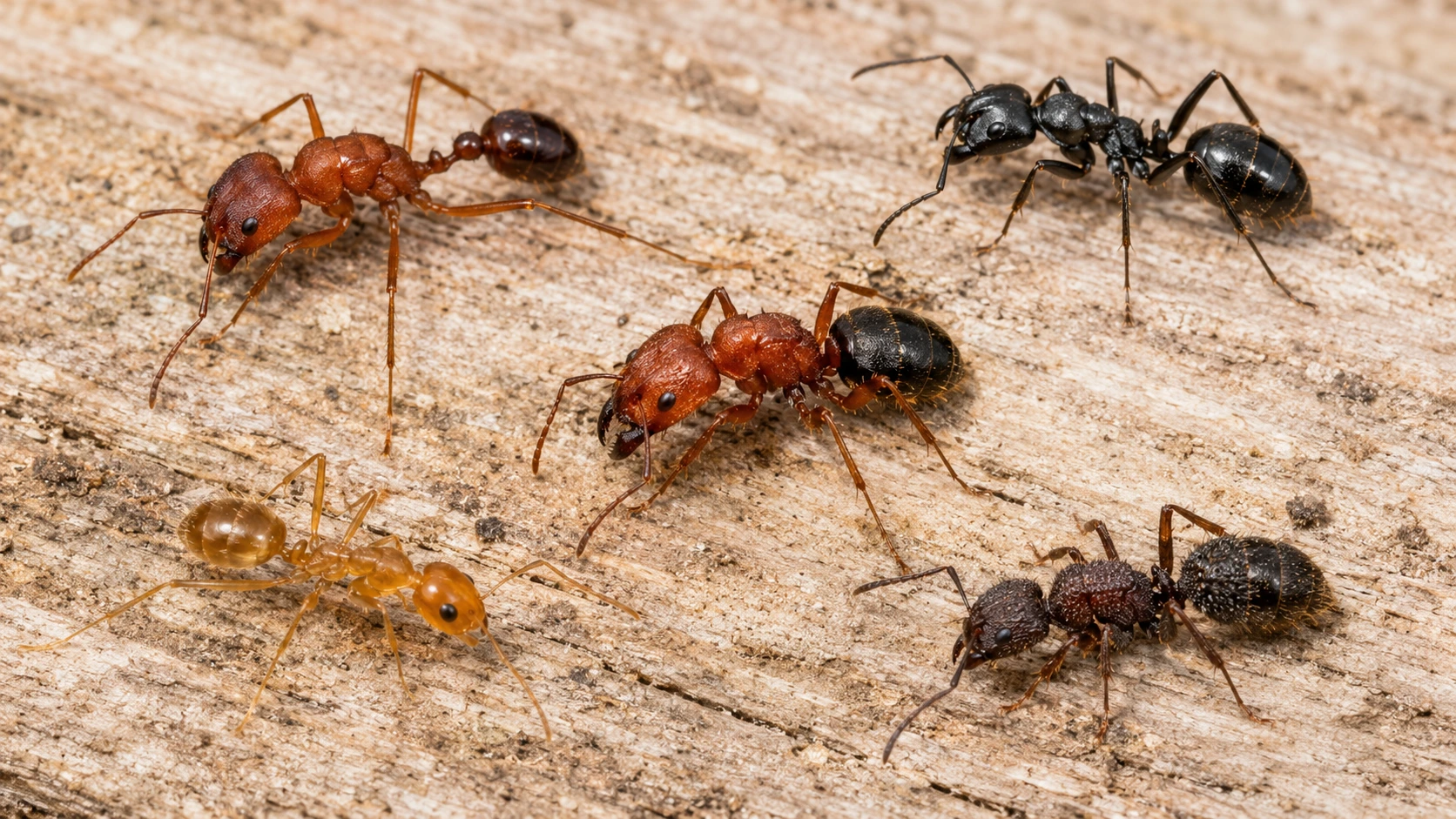
This guide covers the five most common ant species in Davenport homes — what they look like, where you’ll find them, and what their presence tells you about where the colony is and how serious the problem is.

Ready to Take Back Your Home?
Why Ant Identification Is the First Step to Getting Rid of Them
Every ant species has a biology that shapes how it behaves, where it nests, and how it responds to treatment. A product that kills one species on contact may cause another to panic and split into multiple colonies, turning one problem into five.
There are two broad treatment categories for ants, and the wrong choice for your species is worse than no treatment at all:
Repellent treatments — Contact sprays and repellent barriers that kill or deter ants on contact. Effective for some species, disastrous for others. Fire ants, odorous house ants, and carpenter ants respond reasonably well to repellent approaches when applied correctly. Ghost ants and pharaoh ants do not.
Non-repellent / bait treatments — Slow-acting baits that foraging workers carry back to the colony, eventually reaching the queen. Required for ghost ants, pharaoh ants, and any species where colony elimination — not just surface suppression — is the goal. Bait treatments take longer to show results but actually solve the problem rather than relocating it.
Knowing your species tells you which category applies. Everything else follows from there.
The 5 Most Common Ants in Davenport Homes
1. Fire Ant (Solenopsis invicta)
What they look like: Reddish-brown to dark brown, 1/8 to 1/4 inch long. Workers vary in size within the same colony. No visible distinguishing features that set them apart from other small ants at a casual glance — the key identifier is the mound and the behavior.
Where you’ll find them: Almost exclusively outdoors. Fire ants build distinctive dome-shaped mounds in open lawn areas, garden beds, and along driveways and sidewalk edges. They do not typically trail indoors unless a mound has been disturbed or the colony is under significant stress.
What their presence means: An established outdoor colony, most likely in your lawn. Single mounds are manageable. Multiple mounds visible at once indicate a well-established population that requires broadcast treatment, not just individual mound treatment.
Urgency level: High. Fire ants sting aggressively and repeatedly when disturbed. The risk to children and pets using the yard is significant. For full detail on timing and treatment, see our fire ant season guide and our fire ant stings article.
Treatment approach: Individual mound drench combined with broadcast granular bait applied across the full lawn. Perimeter barrier treatment helps prevent new colonies from establishing near the home.
2. Ghost Ant (Tapinoma melanocephalum)
What they look like: Extremely small — roughly 1/16 inch long. The body is two-toned: dark brown or black head and thorax, pale or nearly translucent abdomen and legs. At a glance they can be almost invisible, which is how they got their name. If you see tiny ants that seem to disappear against light-colored surfaces, ghost ants are the most likely culprit in Davenport.
Where you’ll find them: Indoors, primarily. Ghost ants trail along kitchen countertops, inside cabinets, near sink drains, along bathroom grout lines, and around any consistent moisture source. They prefer warm, humid environments and are extremely common in new Davenport construction where the home’s moisture levels haven’t fully stabilized.
What their presence means: A colony — or more likely multiple satellite colonies — established either inside your walls or in the soil directly outside your home with foragers traveling inside through plumbing gaps and baseboards. Ghost ants almost always have multiple queens and multiple nesting sites simultaneously.
Urgency level: Medium-high. Ghost ants don’t sting, but they are very difficult to eliminate without professional treatment and will not go away on their own. Read more in our dedicated ghost ants in the kitchen article.
Treatment approach: Gel bait only. Repellent sprays cause colony fracturing and make ghost ant problems significantly worse. Bait must be placed in low-traffic areas along established trails and near suspected entry points. Exterior perimeter treatment addresses the outdoor colony base.
3. Florida Carpenter Ant (Camponotus floridanus)
What they look like: The largest ant you’re likely to encounter in a Davenport home. Workers range from 1/4 to 1/2 inch long. Typically black or dark reddish-brown, sometimes with a reddish mid-section. Their size alone usually makes them identifiable — if the ant you’re looking at seems big, it’s probably a carpenter ant.
Where you’ll find them: Along baseboards, window frames, door frames, and anywhere wood meets another surface. They trail between outdoor primary colonies and indoor satellite nesting sites, usually at night. Finding them repeatedly in the same location — particularly near wood — is the most important indicator.
What their presence means: A primary colony exists somewhere nearby — in a dead tree, rotting stump, or old wood on your property — and a satellite colony may already be established inside your home’s wall voids or structural wood. The presence of winged carpenter ants (swarmers) indoors is a near-certain sign of an established indoor colony.
Urgency level: High. Carpenter ants damage wood structurally. Early treatment is significantly less costly than waiting. See our full carpenter ants damage article for what to look for and when to act.
Treatment approach: Non-repellent insecticide applied to wall voids and gallery areas, combined with exterior perimeter treatment and elimination of the primary colony site. Landscape modification — particularly pulling mulch away from the foundation — is part of any complete treatment plan.
4. Pharaoh Ant (Monomorium pharaonis)
What they look like: Very small, roughly 1/16 inch long. Light yellowish to orange-brown body, sometimes with a darker abdomen. Similar in size to ghost ants but warmer in color. Pharaoh ants are often confused with ghost ants, which is a costly mistake because they require the same treatment approach for completely different reasons.
Where you’ll find them: Deep inside structures. Pharaoh ants prefer to nest in wall voids, behind baseboards, inside insulation, and near plumbing — anywhere warm, protected, and close to moisture. They are most common in multi-unit buildings but are found in single-family Davenport homes regularly, particularly in newer construction where they can establish inside wall cavities before the home is fully settled.
What their presence means: A well-established indoor infestation. Pharaoh ants are polygyne — they have multiple queens per colony — and they reproduce rapidly. A small visible trail is typically the surface indication of a much larger colony established deep in the structure.
Urgency level: High. Pharaoh ants are among the most difficult ant species to eliminate and will spread aggressively through a home if treated incorrectly.
Treatment approach: Bait only — this cannot be overstated. Repellent sprays or contact insecticides applied to pharaoh ants cause the colony to bud into multiple satellite colonies, each with a new queen. One infestation becomes many. Only slow-acting bait placed throughout the structure — not just at the visible trail — effectively eliminates pharaoh ant colonies.
5. White-Footed Ant (Technomyrmex difficilis)
What they look like: Small, roughly 1/8 inch long, uniformly dark brown to black with pale, whitish feet — the detail that gives them their name. They are often mistaken for odorous house ants or other small black ants and are underidentified in Davenport despite being extremely common.
Where you’ll find them: In large numbers, both indoors and outdoors. White-footed ants are notable for their colony size — mature colonies can contain hundreds of thousands to several million workers. They trail extensively along exterior walls, around windows, along roof lines, and inside along baseboards and wall junctions.
What their presence means: A very large colony — possibly one of the largest you’ll encounter in a Davenport home. Because roughly half of all workers in a white-footed ant colony are reproductively capable, the colony is extremely resilient to treatment and difficult to eliminate completely.
Urgency level: Medium. White-footed ants don’t sting and don’t damage wood, but their sheer numbers make them a persistent nuisance that self-treating rarely resolves. Colonies require sustained perimeter treatment and targeted baiting to suppress.
Treatment approach: Combination of exterior perimeter barrier treatment and targeted bait placement. Due to the colony’s size and the fact that foragers do not share food with the reproductive portion of the colony the same way other species do, baiting alone is insufficient. Consistent perimeter treatment applied on a quarterly schedule is the most effective management approach.
Ready to Take Back Your Home?
Quick Reference — Ant Identification at a Glance
| Species | Size | Color | Where Found | Sting? | Bait or Spray? |
|---|---|---|---|---|---|
| Fire Ant | 1/8–1/4″ | Reddish-brown | Outdoor mounds | Yes | Both |
| Ghost Ant | 1/16″ | Dark head, pale body | Kitchen, bathroom | No | Bait only |
| Carpenter Ant | 1/4–1/2″ | Black / dark red | Wood, baseboards | No | Spray + bait |
| Pharaoh Ant | 1/16″ | Yellow-orange | Wall voids, plumbing | No | Bait only |
| White-Footed Ant | 1/8″ | Black with white feet | Exterior walls, indoors | No | Both |
When to Call for a Professional Identification
For a lot of homeowners, the table above is enough to make a confident identification. But there are situations where guessing is not worth the risk:
- You’ve already treated and the ants came back or spread to a new area
- You’re seeing winged ants indoors — this almost always indicates an established indoor colony and requires a professional assessment
- You suspect carpenter ants but aren’t certain — the damage implications make it worth having a professional confirm
- You’re seeing two different species and don’t know which is which
We serve Davenport and surrounding areas including Haines City, Winter Haven, ChampionsGate, and Polk City. A technician can identify your species on-site, assess the extent of the infestation, and apply the correct treatment the first time. Visit our ants we treat page to see the full list of species we handle, or explore our services page to understand the treatment options available for your specific situation.